
2025 Q2 Letter
Venture Capital in transition
It’s not a downturn, not a rebound, and not a bubble. It’s a market in transition, where pricing, pacing, and priorities vary dramatically by stage, sector, and story. Rather than moving in a single direction, the market is being pulled in four directions all at once.
1. AI is its own force.
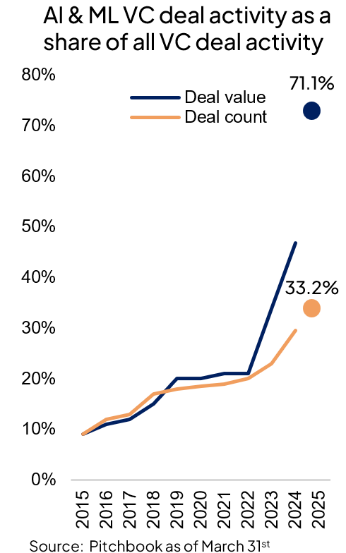
In Q1 2025, AI companies accounted for 71% of total venture dollars and a third of the total deal count.
This isn’t just hype. AI is creating a true shift to one of those rare moments when startups can leverage new technology to build better products fast and out-execute incumbents. We’ve seen teams go from $0 to $10 million in annual recurring revenue (ARR) in less than a year. It seems like daily headlines about startups getting to $100 million in ARR in record times. Such velocity creates its own gravitational pull and it’s attracting capital, talent, and attention. AI is also distorting the rest of the market. 70% of all AI financings in Q1 were seed or Series A, and those rounds soaked up a disproportionate share of capital. It is raising the bar for what early-stage companies must look like to get funded and likely accelerating the exit timelines for a subset of breakout companies.
2. Late stage is having a moment.
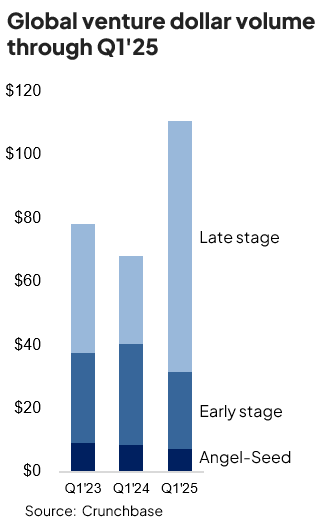
Late-stage startups are gaining momentum—both as a share of total venture activity and in absolute dollars raised. Several dynamics are driving this.
First, consolidation among VCs has funneled capital into a smaller number of huge funds. These firms write fewer, bigger checks, naturally tilting them toward later-stage rounds. Second, LPs who have been burned by the lack of distributions are pushing GPs to invest in ways that will produce nearer-term liquidity. And third, late-stage valuations have already reset from the inflated ’21-’22 era, making the entry point feel more rational (exceptions for AI startups).
3. Non-AI Early stage is stuck.
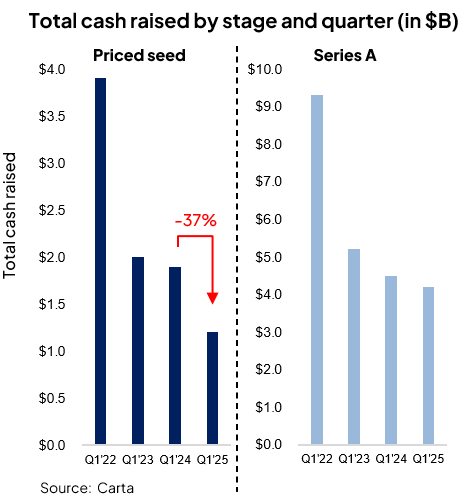
Seed and Series A activity has fallen off. In Q1 2025, the total cash raised in priced seed rounds dropped 37% year-over-year, and Series A dollars are down 6%.
Many startups also just aren’t progressing. In Q1 this year, 46% of Seed rounds were bridge rounds led by existing investors, not new institutional leads. The time between Series A and B has stretched from about two years in Q3’23 to close to three years today.
Solid but non-AI businesses that would have been easily fundable five years ago now seem too slow or too hard to underwrite by comparison. For LPs, such early-stage rounds imply a decade or more of locked up funds in an environment where illiquidity feels like a bigger penalty than it used to. That’s giving an edge to late-stage investments, where there’s at least a chance of an exit on the horizon.
4. Liquidity is showing *small* green shoots.
The most important structural issue in venture remains unresolved: LPs still aren’t getting capital back.
Just maybe there is some light at the end of this long tunnel. The value of VC exits has risen for three quarters in a row. Some of this is due to IPOs, though notably, virtually all the startups that went public this year have listed their IPOs below their last private rounds, making them down rounds. That’s not ideal for LPs, but it is healthy. Valuations are resetting and capital is making its way back to LPs.
M&A also picked up. Q1 2025 set a record for billion-dollar venture exits, with a dozen such deals led by Alphabet’s $30 billion acquisition of Wiz. That surpasses prior high watermarks, including Q1 2000 and Q4 2020. The recent sale of Melio to Xero for $2.5 billion is telling. Melio was last valued at $4 billion in 2021—when it generated only $6 million in revenue. This outcome is also technically a “down round,” but it still recycles real capital back into the ecosystem
Attention now shifts to the IPO pipeline. A cohort of fifteen companies—Figma, StubHub, Klarna, Gemini, Navan, Cerebras, Netskope, Genesys, Discord, Stripe, Revolut, Anduril, Ramp, Pine Labs, and Groww—could collectively list at $250 billion–$400 billion in enterprise value and return more than $100 billion to venture investors and their LPs.
Core Thesis, Expanding Opportunity
Our thesis is unchanged: In markets where distribution determines outcomes, human sellers frequently outperform direct-to-consumer brands, and platforms that give those sellers leverage will capture disproportionate value.
This was clear to us in the industries where we started. Insurance, wealth management, and real estate all have essential “producers” such as agents, brokers, and advisers. Over the past twelve months, however, referrals have drawn us into adjacent sectors, including investment banking, healthcare, travel, law, consulting, the creator economy, and more. Founders in these spaces are building “business in a box” or “operating systems” for entrepreneurial professionals. In every case the same patterns appear:
• The human seller endures. A nurse practitioner who has built a private practice clientele through personal care does not lose those relationships to a D2C app.
• Production follows a power law. The top 20 % of “rainmaker” producers generate roughly 80 % of revenue, economics that are misaligned with flat per seat SaaS pricing.
• Holistic, transaction-based solutions win. By charging a percentage of the transaction (or revenue/profit) and expanding their offering over time, these platforms capture a greater share of economics, create strong producer lock-in, and build wide competitive moats.
• Aggregating demand activates growth flywheels. By consolidating demand, platforms can trigger powerful network effects or extract margin from other ecosystem participants.
Of course, not all opportunities are created equal. The very exciting opportunities tend to have structural mechanisms that cause rapidly accelerating flywheels or network effects. We now score startup investment opportunities on indicators of faster growth and stronger moats:
• Producer productivity gain: The magnitude of savings in time and operating costs.
• Economies of scale: The potential margin improvements that could occur when the platform scales.
• Producer lock-in: The contractual, workflow, or community ties that reduce producer churn after onboarding.
• Network-effect power: Data loops that improve matching, pricing, or risk selection.
• Supplier & adjacency capture: Potential to create new revenue streams independent of producers.
• Market fragmentation: The number of producers, manufacturers (supply), and end clients (demand).
• Demand portability: Extent to which clients follow a rainmaker onto the platform.
• Take-rate durability: Tolerance for percentage-of-transaction pricing over time from producers.
AI Supercharges Rainmakers
We believe this is the start of a massive wave of change. So many markets that haven’t been disrupted by technology now will be. But even if development costs are plummeting for startups, the moats and growth flywheels of our thesis business model remain. This suggests that startups will be able to sweep their markets in a fraction of the time it would have taken a few years ago. We anticipate massive consolidation within producer-led industries and rapidly shifting economics for suppliers.
The core pitch from our startups is simple: “You’re only spending 50% (or less) of your time on revenue-generating tasks; we’ll help you get to 90% revenue-generating time.” Their platforms eliminate friction—both in transactions and ongoing support—and take over critical but non-core business functions like finance, HR, and operations, often at a world-class level. This both streamlines work and enables better service, making producers more attractive to clients.
Consolidated distribution remains the decisive advantage for these platforms. It gives them negotiating leverage across the supply chain, which means that they can capture incremental margin while still improving the economics for producers.
Our refined opportunity scoring, combined with accelerating AI tailwinds, positions Viewpoint to underwrite and support the next generation of category leaders. And the universe of producer-led industries addressable by this model is far larger than we initially assumed.
AI Enabled Roll-ups: Similar Themes, Different Playbook
Several high profile VC franchises—General Catalyst, Thrive, Khosla, 8VC, and others—are funding “AI roll-ups.” This model also targets fragmented, services heavy markets and applies automation to unlock operating leverage. In other words, it’s in the same key as our thesis, but is a different song. The similarity ends at how scale is achieved—and what that means downstream.
Roll-ups buy product market fit. They spend cash to acquire mature, profitable firms that can be retrofitted with AI. This attracts owners who are often looking to exit or wind down—in other words, they are looking for liquidity, not growth. Once their earn outs expire, top producers can—and frequently do—leave, forcing the platform to rebuild by acquiring the next book of business.
Viewpoint’s approach inverts this. We back founder led platforms that have earned product market fit through organic growth. Their purpose-built software removes administrative friction, enabling top producers to grow faster than they could alone. These rainmakers opt in not for liquidity, but for acceleration. And as they succeed, they reinforce the platform: each new high performer raises service quality, strengthens retention, and increases the appeal to the next cohort.
We continue to believe that platforms built to serve practitioners who already own durable customer relationships will generate more resilient economics than those assembled primarily through capital. And in our view, AI is more likely to widen that gap than close it.
As always, thank you for your ongoing partnership and support.
Fondly,

Drew Aldrich, Managing Partner
Building in a producer
market? Let’s talk