
2024 Annual Letter
Dear Partners, ███, and Friends,
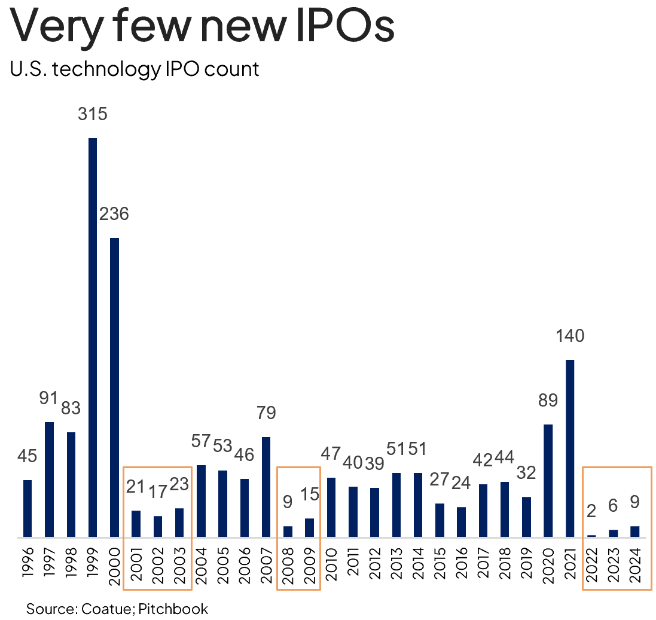
Heading into 2025, the venture capital market has a new vibe. Optimism is on the rise again. Why exactly? For most, it’s the combination of the dawn of the AI era, plus the election of a new business-friendly administration (stocked with VCs, no less) that could cut regulation and get private equity firms and corporations back into acquisition mode. It might even break what some have called a 25-year backlog on IPOs.
I’m not entirely convinced this optimism will last. I can easily imagine chaos swallowing this moment of exuberance. Will we see rising inflation or recessions if we enter a new mercantile era of tariffs? Who knows. Will the VC-heavy set of White House advisors stay in the administration’s good graces? No clue.
Still, what will matter to venture in the immediate future is this: Will the M&A/IPO logjam finally break? If it does — and anecdotally, we are hearing a lot about how busy M&A bankers are since the election — it’ll free up capital that’s been locked up for years now in prior vintage funds. Reinvigorated LPs, infused with capital and enthusiasm for AI-tech startups, will plow back into venture. That could snap VC out of the doldrums after 10 dour quarters. Sure, zombie startups will still be stumbling around from the irrational ’20-’21 VC funding bubble, and some will run out of steam, but I’m hearing less worry about them dragging down the whole asset class.
At Viewpoint, we have our own reasons to feel optimistic: in 2024 our portfolio proved that we weren’t crazy. We called our shot three years ago, when we started building a different kind of VC fund and investing in our specific thesis. Last year showed that we are on to something big. As we are finalizing our Q4 results, we expect to be within the top quartile for 2022 vintage VCs. This is true even without any markups on two of our largest, best-performing positions (Farther and Spark) because they are recent. Even Goodwin, our earliest-stage investment, has grown 100%+ QoQ and will complete a second outsider-led round since we invested (coming with a likely 185% markup, which is not included in our Q4 return marks).
Our Thesis at Work
Our companies are thriving. You can see this throughout the portfolio but it’s most important in our top three positions, which together comprise greater than 70% of Fund I’s invested capital: Farther ($29 million invested), PLACE ($20 million invested), and Spark ($20 million invested).
Farther, a tech-enabled registered investment advisor (RIA), has grown 90% since we priced our investment less than six months ago. (It has grown 770% since we identified it as an investment target in June ’23.) This growth is remarkable. Assuming traditional RIA valuation metrics, Farther should return our entire fund when it reaches $50B in assets under management. At this rate of growth, that could be in less than two and a half years. And that scale is only 0.5% of the entire RIA market. It’s unclear what, if anything, limits Farther’s growth potential.
Our initial decision to bet on our thesis and be a high conviction, concentrated fund meant we had raised the level of difficulty. Our “hit rate” needs to be far higher than the traditional VC fund. The only reason we could do this is because we knew something other VCs didn’t: our thesis. The above-named companies represent over 90% of Viewpoint’s deployed capital. This is Viewpoint’s thesis and strategy at work.
Viewpoint’s Alpha
Venture capital, much like hedge funds or private equity, is fundamentally about seeking “alpha”—returns above a relevant benchmark. I find it helpful to think of alpha as a hidden insight into an asset’s true worth. At first only a few investors see this potential, which enables them to earn outsized gains.
At Viewpoint, our alpha stems from recognizing that a particular set of business models, in a particular set of “producer-led” industries, will generate disproportionate returns—well above what the broader market expects. If you’ve been following these letters, you’ve witnessed how our articulation of this thesis has evolved. Here’s how we describe it today:
Over the past two decades, many of the biggest venture success stories—think Amazon, Uber, Airbnb, or Spotify—sprang from startups that aggregated consumer demand on a single tech-enabled marketplace platform. By concentrating demand, they effectively compelled the supply side to plug into their systems, unleashing powerful flywheels (including network effects) that led to industry domination.
But in many industries (insurance, real estate, wealth management, etc.) demand is controlled by human intermediaries. Brokers, agents, advisors, and small business “rainmakers” can’t be replaced by technology. Viewpoint backs startups that aggregate these intermediaries rather than bypassing them, building the next generation of dominant marketplace platforms in sectors where people, not just software, drive demand.
By definition, a specific alpha is finite; once other investors catch on, collective buying and selling pushes the price closer to fair value. But Viewpoint was ahead of the pack for two reasons:
1. We began as insurance-focused investors. Insurance isn’t just one “producer-led” sector; it’s really adozen or more distinct markets—term life, Medicare Advantage, ACA, group health, voluntary benefits, personal lines Property and Casualty (P&C), small commercial P&C, large commercial P&C, E&S, annuities, and so on. We saw how indispensable human producers are across each of these verticals and recognized similar patterns in other markets.
2. Earlier startups in producer-led markets were bootstrapped. Historically, the best large-scale versionsof our thesis got little or no VC funding. Goosehead—a tech-enabled P&C personal lines broker—is a primeexample. By focusing on building a highly efficient platform—while keeping the human agents front andcenter—Goosehead scaled rapidly. At its IPO in 2018, it was valued at $362 million; it’s now valued at nearly$4 billion. Had Goosehead been VC-backed, I believe there would be far more competition in our thesisbecause other VCs would have seen how powerful this tech-enabled producer model is. (Another interestingversion of our thesis is a UK-owned “vice” startup with no VC funding that passed $1.3 billion in revenue in2023 and is rumored to be extremely profitable.)
Viewpoint’s Edge
These advantages gave us a tremendous head start. But we want Viewpoint to be the unquestioned VC of choice for our thesis-fit startups. So as other VCs wake up to the power of producer-led marketplace businesses, we must keep improving our competitive edge.
An edge is some way to spot and leverage opportunities in a way that is both repeatable and difficult for others to replicate. It could be a unique strategy, specialized skill, proprietary data, superior deal access, or the ability to win the right to invest. Every decision we’ve made for Viewpoint was intended to grow our edge. Some, like building a specialized network of insurance leaders, gives us superior information and makes us the preferred VC for insurance startups that fit our thesis.
This approach, however, only works if founders also choose to partner with us over other “tier 1” investors. We believe we have an edge here, too: founders appreciate our expertise, our data-driven insights, and our ability to gain true, informed, independent conviction about their businesses.
Our Power of Conviction
Our greatest edge right now is our ability to reach conviction faster and to a higher level than other VCs. As a tactical example, we intentionally avoid certain risks, like product risk. We invest at later stages, after the product has been built and scaled. Similarly, while other VCs may focus on analyzing founder quality, we typically invest when the company has grown enough that the likelihood of a “bad” founder is low.
By contrast, we readily take on revenue expansion risks. If a startup in a producer-led market has already aggregated a critical mass of demand, it will find powerful ways to monetize once it scales. We’ll make that bet every time.
At this moment, I believe our edge is expanding, not contracting. I believe no other investor has access to this set of founders who are building this “producer-led” business model. We spend countless hours with them discussing how “producer-led” models evolve and what strategies thrive under specific conditions.
Staying a Step Ahead
While our edge is expanding, I can feel an increase in competitive pressure. Some of it stems from the increasing deal flow for generative AI workflow platforms that supercharge “rainmaker” industries such as law and accounting. These tech-enabled platforms allow the “rainmaker” to spend less time on non-value-added activities and more time on finding new clients. These startups do not use the term “producer,” but they fit our model well. Similarly, pressure is coming from vertical market SaaS (VMS). The success of ServiceTitan, which had its IPO last month, signals an evolution in “SaaS” into “all-in-one” solutions offering front-office, field management, marketing and management tools for building trade contractors. Our thesis is different in important ways, but those pursuing a VMS strategy will eventually realize there is a powerful, highly related thesis right next door.
One of the more exciting edge-expanding initiatives is our inaugural Viewpoint Founder Retreat in the second half of the year. We will be hosting an intimate gathering of founders who all share our thesis but operate in non-competing industries. Our goal is ambitious: we want this two-day experience to rank among the most impactful events our founders attend all year. Because we’re effectively creating a new category of “producer-led marketplaces,” many of these founders have never been in the same room with so many peers tackling the same fundamental challenges. I can’t wait to see what discussions unfold and what connections form.
This year we’re also focused on our Viewpoint Fund II fundraise, which kicked off in November. This will enable us to add critically needed capacity to our team. Each month, we learn about a new thesis-fit startup in a market we have never explored. It’s simultaneously thrilling and scary to realize dozens of these startups could be primed for the kind of breakthrough growth we’ve seen in our portfolio. Nothing is preventing us from finding and investing in them all except that we haven’t had the time or resources to assess each producer-led market systematically. We suspect there are more than 50 markets, each with a handful of investible startups in them. With just a few more investors on the team, we likely can systematically map all thesis-fit startups across all markets within a year or two.
Reflections on 2024
We also further deepened our engagement with the insurance industry. We hosted our third annual summit at InsureTech Connect, drawing 250 senior insurance executives, and traveled extensively to share our views on AI with leaders at dozens of insurance carriers. If you haven’t seen our AI presentation yet, we’d be happy to discuss how it might benefit your organization.
I look forward to seeing and catching up with many of you in the coming weeks and months. As always, thank you for your partnership and support.
Fondly,

Drew Aldrich, Managing Partner
Building in a producer
market? Let’s talk