
2023 Q3 Letter
Dear Partners, ████ and Friends,
The venture market today looks like a “pig in the snake” situation. The class of startups that raised capital in 2020 and 2021 — when company valuations were over-inflated — are now like over-stuffed snakes “digesting” a giant pig of excessive capital.
Funds that focus on series B or later will struggle to find great investing opportunities for two simple reasons: Many startups have all the money they need and then some. Those that are out of money aren’t likely living up to expectations. The flow of deal-making will stay sluggish until all that money gets digested.
Viewpoint’s strategy for sourcing deals and making investments has, fortunately, allowed us to adjust to these conditions.
Venture capital is in a "pig and the snake" situation
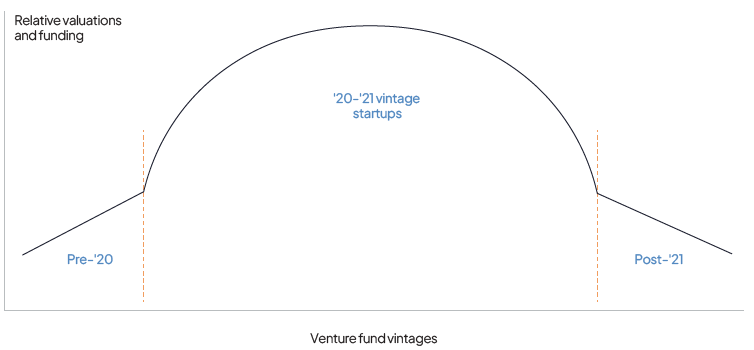
According to PitchBook, more than 27,000 U.S. venture deals got completed in 2020 and 2021 — though it’s likely some startups completed fundraising rounds in both years. Conservatively, then, during this two-year bubble about 20,000 distinct startups raised almost $500 billion. That was more than triple the amount raised five years before ($169 billion in 2015 and 2016.)
The prices paid in 2020-21 were far in excess of what these startups’ traction normally would have warranted. But the VC market was stuck in an accelerating cycle: Interest rates were low, so those looking for returns put money into venture capital.
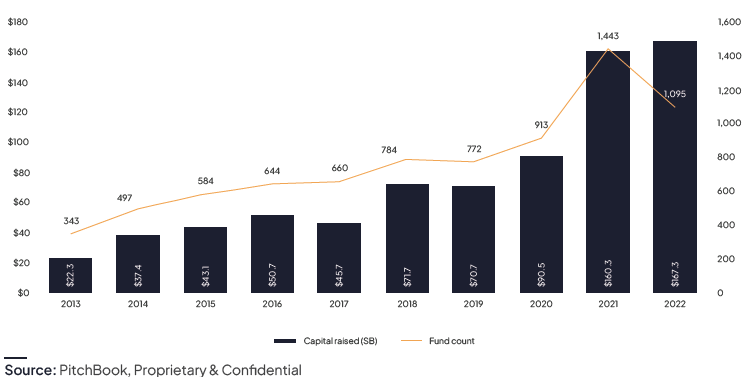
The capital flow, however, outpaced the number of worthy startups. That led to startup price inflation. The high valuations given to startups was mistaken for actual performance, attracting even more investments, and so on. After an average growth rate of 18% YoY from 2013-2019 ($22 billion to $71 billion), the VC fundraising grew 31% in 2020 (to $93 billion), and then an astounding 65% in 2021 (to $154 billion).
VC fundraising sets new annual high despite slowing deal pace
US VC fundraising
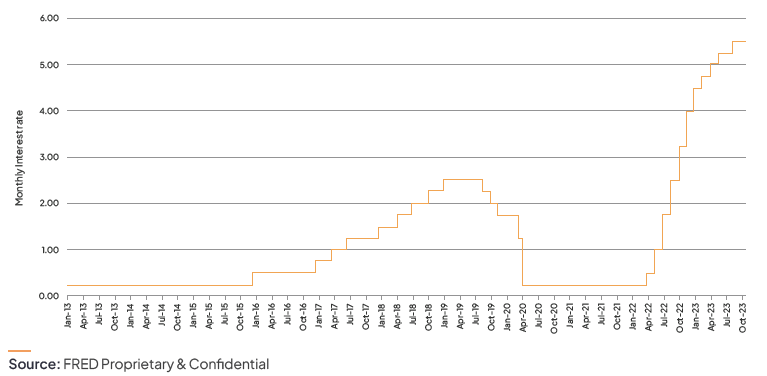
The bubble might not have deflated so quickly, though, had inflation and interest rates not soared starting in Q4’21. But rates did rise, offering investors cozy harbors of zero-risk returns. Tech stocks and other illiquid assets tumbled. And tens of thousands of startups — some still at seed stage — are now left trying to live up to their own overblown valuations.
Federal funds target rate
This has created a real problem for venture firms. Many general partners (GPs) and limited partners (LPs) tightened up their investment underwriting following the collapse of Silicon Valley Bank last spring.
And yet for those that invest in series A, B or later stages, this overpriced cohort is the near totality of investment opportunities available to them.
Only a sliver of those startups will likely live up to the hype their 2020-21 valuations implied (my rough guess would be 1 in 1,000). Those 20 or so companies will be able to raise at a higher price in the near/ medium term with little friction. The remainder fall into three unequal buckets:
Self-sustainers
These companies can use the large pool of capital they raised at high valuations to build a self-sustaining business and never raise again. I am guessing this is probably 10% of the group.
Slow growers
These companies may grow into their valuations, but also may have to raise at a flat round in the near term. Some, despite attempting to conserve cash, won’t grow enough to justify their last valuation, but are still interesting enough to have a successful raise. They will have to do a down round. This is probably the bulk of startups, perhaps 50%.
Cash-burners
They will run out of capital, be unable to raise, and will go out of business or be acquired with investors receiving less than their investment. My guess is about 40% will wind up in this bucket.
Highest number of startup shutdowns yet in Q3 2023
Startups on Carta shutting down due to bankruptcy/dissolution
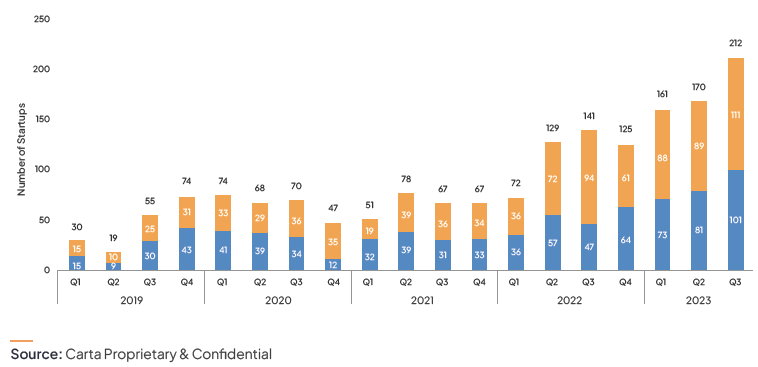
Until the pig is digested, the venture market is stuck in a semi-frozen state. The only startups able to attract capital without difficulty are: brand new startups; the few that have lived up to their hyped valuation; or some that did not raise during ’20-’21 but want to now. The rest will wait until they’ve grown into their valuations, or they run out of cash.
Ultra-early-stage-focused VCs are in the best position because virtually all the companies they look at are less than 24 months old, so are unencumbered by this market dynamic. But later-stage-focused VCs are struggling. They have capital they have to deploy for investors, and not a lot of great places to put it. Virtually all the startups created pre-2022 are impacted by “pig in the snake” dynamic.
This affected Viewpoint somewhat indirectly last quarter. We identified an exciting startup, proposed to invest ██ ██ ███████████ ████ ██████████ and were still outbid. Great opportunities are scarce, so the few that emerge are still receiving stratospheric valuations reminiscent of ’20-’21.
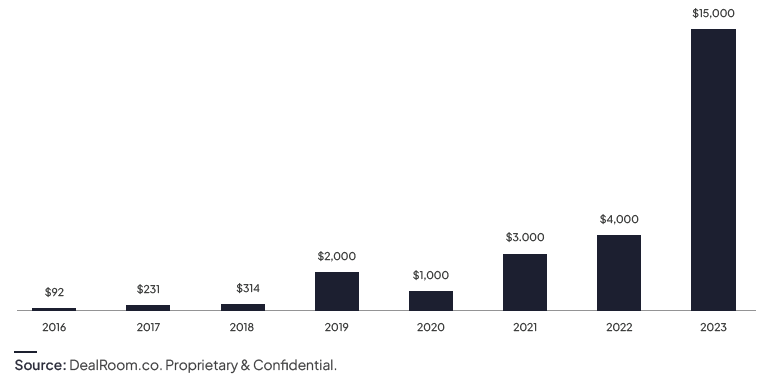
This scarcity also might explain the eye-popping valuations given to generative AI startups. To be sure, “gen-AI” is extremely exciting — but it is also so new that investors can extrapolate to astronomical market sizes. OpenAI’s ChatGPT, which launched the gen-AI era, came out in Q4’22, so this pool of startups is untainted by the excesses of ’20-’21. Still, I believe a contributing factor to the high valuations is that large VCs are starving for opportunities to put their money to work.
Global generative A.I. VC investments
Values in $M
Thematic Investing in a Dislocated Market and the Power of Secondaries
You all know that Viewpoint is a deeply thematic fund focused on specific theses that we believe will hold true no matter what the venture capital market conditions are. This makes it relatively easy to identify the companies that are a good fit for us. However, a number of them are still in the digesting phase: they are valuable businesses but have artificially high valuations from a prior round, and have no current need to raise. Viewpoint can wait. Most stage-focused VCs cannot.
That doesn’t mean Viewpoint is immune to the challenges of these market conditions; we will likely add only one or two companies to our portfolio in 2023 (compared with four in 2022). ████████ ███ ████████ ████████████ ████████ ███████ ██ ████ █ ██████ █████████ ██ ████ ██████ ████████████ All our portfolio investments were done “off-cycle.” These companies were not actively looking for capital when we invested. We know we don’t have to wait for a formal fundraising round to invest.
To that point, the last two additions to the Viewpoint portfolio were done through “secondary” investments.
The vast majority of VC dollars are used for “primary” investments, where a VC fund buys shares from a company; this gives the company use of the investment proceeds but dilutes the shares of all prior investors.
In a secondary transaction, an existing stockholder sells their stock directly to another investor, so although the company does not get additional capital to use, existing investors are not diluted.
Secondaries Come With Opportunity and Risk
Secondary investments are rare in venture capital for various reasons related to securities laws. Secondary common shares are very different than the preferred equity acquired during a standard venture capital round. Preferred equity comes with valuable investor protections that allow it to trade at a premium. Most importantly, preferred equity typically has a “1x liquidation preference,” which means that those preferred holders get their money back before the rest of the stockholders. Preferred shares also tend to confer special voting rights, such as the ability to veto certain corporate actions.
Investing in common shares, with no such liquidation preference, adds meaningful risk. For example, if a company sells for below the hoped-for price, primary investors are paid first and secondaries may get much less, or nothing at all.
Secondaries have one major advantage, though: The deal is negotiated directly and privately, unconnected to any fundraising round, or its preferred share price. That also means the terms do not affect how the existing venture investors need to mark their portfolio, nor does it affect how the company needs to value their broader common shares.
███████ ██ ███ ████████ █████████████ █████████ ███ ██████ ███ █████ █████████████ ███ █████████ ███████████ ████ ███████ ██ ███
Again, secondary investments have higher risks, so Viewpoint needed to be particularly confident in these companies. And we were. ███ ███ ███████ ███████ ████ █ ██████████ ██████ ██ █████ █████ ██████ ███████████ ██ █████ ███████ █████████████ ███████ ██ ████ ████ ████ ██ ███████ ███ ██████ ██ ██ ██████████ █████ ███████ ██ █ ██████ █████████ █████████ ███ ██ ███ ████████
The other company represented an unparalleled thesis fit for Viewpoint. It also did not raise during 2020-21; in fact, they only ever raised a small amount, and their last VC round was six years ago. ████ ██████ ████ ████████ ████ ████ ████████ █████████ ███ ███ ███████ ███████. But Viewpoint’s thematic focus and industry access made us attractive as investors to the management team, so we were able to come to terms.
Secondaries will continue to be in Viewpoint’s toolbox during this seized-up venture market. But it’s one we’ll use sparingly, and only when we encounter an extraordinary situation with great risk-adjusted return potential. It is also not the only tool we are using during these times. We are currently assessing a few other unusual transactions. In some, we’ve identified an attractive, thesis-relevant asset which we might be able to extract from a larger organization. In other cases, we are weighing unusual-to-venture opportunities brought to us by our network.
We’ll look at these new opportunities just as we always do: Sizing up their fit to our theses and reflecting. Do we understand something about the value of this asset, situation or opportunity that others aren’t seeing? Does our analysis and belief in our theses give us a unique edge in this situation, or are we being adversely selected?
I suspect that in a few years, we will be doing far fewer of these atypical transactions. But in this market environment, I am grateful we have our thesis as our true north to identify value.
Exciting Non-Deal updates
We are in full InsureTech Connect (ITC) prep mode!
ITC, Oct. 31-Nov. 2, is Viewpoint’s “Super Bowl.” I’ve been going to ITC Vegas, the largest insurtech conference in the world, since its founding 2016 and it is the most productive and exhausting three days of the year. We suspect 75% of our 75 network partners will be in Las Vegas for ITC, plus the majority of the 1,000+ startups in our proprietary deal database (a.k.a. The Brain). We hope we’ll see you at one of our dinners, or the ITC Corp Dev / Innovation / Strategy kick-off summit we’re hosting on the first day. Seven Viewpointers will be there meeting with carriers and startups. If it’s anything like last year, our Forward half (Ori, Joanna, Joe) won’t even see our Investing half (Ryan, Chris, Sean) until our team dinner when it’s all over.
Viewpoint is officially launched!
We got a great reception to our announcement. We intentionally emphasized the Viewpoint Forward Network in our press release because we thought that aspect was far more newsworthy than the formation of yet another VC fund. Some of the great writeups are here and here and here.
We’ve released our Tech-Enabled Distribution research!
We began delivering our deep-dive presentation on the future of human distribution (brokers/agents/ advisors) in July. We’ve gotten great feedback from the executive leadership teams who’ve seen it so far. If you would like us to present it to your team, please get in touch.
As always, don’t hesitate to reach out if you’d like to discuss any of this further,
Drew Aldrich, Managing Partner

Building in a producer
market? Let’s talk