
2023 Q2 Letter
Dear Partners, ███, and Friends,
When Silicon Valley Bank collapsed in March, venture capital peered into the abyss. Afterward, there was no denying how vulnerable funds and portfolio companies really were.
In the four months since, it might seem that a new calm has settled over the market. Beneath the surface, however, I believe significant restructuring is underway. There’s still a lot of pain yet to be felt in the venture markets specifically, even compared to other private market investing. For Viewpoint Ventures, this actually presents great opportunities so long as we continue to build our source of alpha ███████████ ██████████ █████████

The VC pullback that I wrote about at the close of 2022 now seems distant. The sense was that things would get back to normal soon. Many funds were leaning into early stage/seed/pre-seed investing because they expected the market to improve enough that the seeded startups would be able to fundraise as needed in a year or two. If venture markets came roaring back, all the better: these bets would ride the demand for investing in Series As. That was the prevailing wisdom.
I saw the issues facing the venture market as more systemic and likely to last longer (see prior letter). This made us here at Viewpoint particularly wary of any startup that would require fresh venture capital investment anytime in the next three years. And that was before the bank run on SVB.
It's hard to overstate the cataclysm that would have descended upon the startup ecosystem had the FDIC not stepped in on SVB. VCs back startups that burn capital, unlike private equity-backed companies, which are more often break-even or profitable. Without access to their bank accounts, a large number of startups soon wouldn’t have been able to meet payroll. If they lost their unsecured deposits and went bankrupt, by law, the founders and board members of these companies would be liable for all unpaid wages. (This measure was put in place to prevent employees from becoming unsecured creditors of bankrupt entities — but in normal situations, boards have weeks or months to deal with oncoming bankruptcy responsibly.) If the government hadn’t backstopped Silicon Valley Bank depositors on that Monday, an unthinkable portion of the venture-backed industry would have collapsed as board members forced startups to furlough everyone to avoid their own personal bankruptcy.
Today, post-near-apocalypse, the calm is masking a lot of market uncertainty for startups, GPs, and LPs.
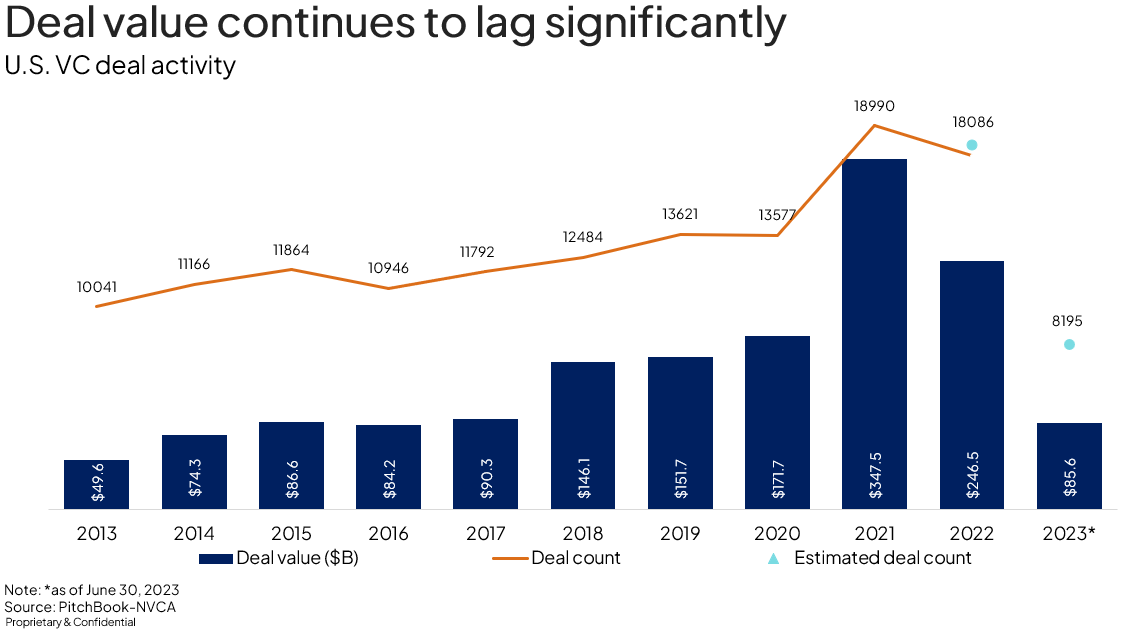
Startups have gotten the message that if they are not among the top 10% of all startups and do not need to raise capital, they should wait. They are getting this cue from GPs, who are themselves deeply uncertain about how to prioritize their undeployed capital. Prompting their concern: LPs have pulled back. So although data shows an extraordinary amount of capital raised by GPs in 2021 and 2022, knowing how this data is collected, most of that was actually raised in 2020 and 2021. Those were also years of heavy deployments, leaving it unclear how much “dry powder” VCs really have.
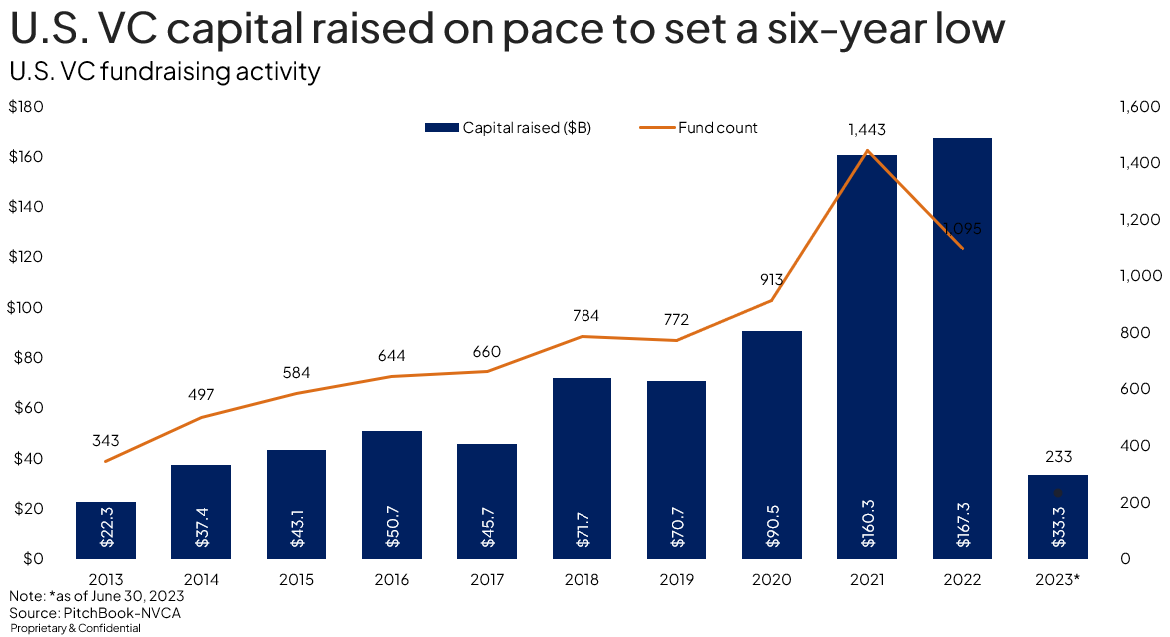
Further, GPs are unsure how long this capital needs to last, and how much needs to be reserved for existing portfolio companies, turning this “dry powder” into what Lux Capital’s Josh Wolfe calls “wet powder.”

LPs have their own level of uncertainty. They recognize that a substantial portion of their paper profits (the Total Value to Paid-In capital - TVPI) will not become actual returns (Distributed to Paid-In returns - DPI). They just don’t know how much of a discount they should apply.
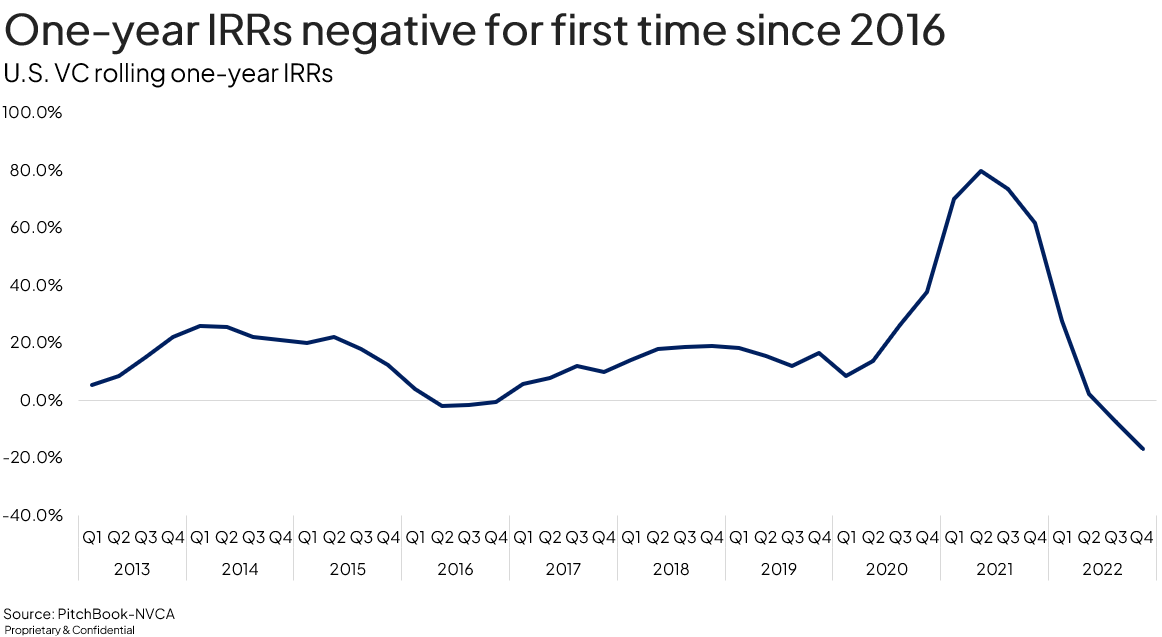
What is clear to LPs is that a significant amount of the "alpha" claimed by their GPs was just "beta" (market correlated returns). The volume of capital flowing into VCs was artificially supporting the entire asset class. And now, capital flows are negative. Meanwhile, yields in other asset classes have risen, making venture capital — with its illiquidity and uncertain returns — even less attractive. LPs will get more choosy about which funds they invest in. And I believe that they will be looking to allocate capital to GPs who have a very clear, defendable source of “alpha,” and whose funds’ structure and strategy clearly align with their ability to capture that alpha. The bar will be very high.
Viewpoint’s Alpha Starts With Our Specialization
There are few venture “generalists” anymore. Venture is just too competitive. Even the large funds create specialist verticals within their fund, whether by stage, industry or theme, or mix of those.
As an example, Haystack is a pure stage specialist. A seed-focused fund, it uses its pattern-matching ability to identify the characteristics of a very early-stage company that can likely make it big, and because it has watched hundreds of companies go from infant to toddler stage, it can give sage advice to founders. Better Tomorrow Ventures (BTV) is a early-stage fintech focused fund (stage and industry focus) and Eos is an early-stage insurance-focused VC fund. Both use their industry knowledge to identify the most promising startups in their space. Tidemark is a growth-stage fund focused almost exclusively on vertical market software (thematic). Union Square Ventures is an early-stage thematic fund that creates a new investment thesis every few years.1
Viewpoint is a thematic fund (stage-agnostic) with an industry sub-specialization. Viewpoint ████ █ is focused on two primary themes: (1) tech-enabled human producers in producer-led industries will create massive winners (including within insurance, but this theme is industry agnostic); and (2) within the insurance industry specifically, there are emerging networked infrastructure winners that will dominate for a generation (insurance industry only).
We believe one of the main benefits of being thematic investors is that we can quickly demonstrate to founders that we’ll provide value to them. We can talk about their business using insights we’ve garnered from studying dozens or hundreds of thematically similar companies. This has been a critical driver for us earning Viewpoint the right to invest in our first four portfolio companies, none of which were actively raising when we made our initial investments.
Being stage-agnostic has added important flexibility, increasing our ability to maximize the alpha capture once we identify it. Our process-driven underwriting can assess early-stage and late-stage companies and we are flexible about the type of security we invest in. This stage-agnostic approach matches well with a specialist thematic approach as it allows us the ability to be flexible in how we invest once we’ve found a great company that fits our theme. We’ve made a seed-stage and late-stage investment, an investment through secondary common shares ███ ██ ██████████ ██ █ ██████ █████████ █████ █████ ████ █ ███ ██████████ ███████████ █████████ Our thematic, stage-agnostic approach even creates the opportunity for incubated investments.
We continuously assess our themes and investment strategy to understand how a changing world affects where the alpha is. Pre-Viewpoint, I was assessing how and if web 3.0 would affect the importance of human distribution. Today we are doing the same with AI. Maybe because the most hyped trends in venture tend to be technical in focus (the direct-to-consumer craze of 2017-2022 as a very notable exception), the promise of these innovations tends to fit nicely within our business model-driven themes. For AI specifically, it’s amazing how quickly our portfolio companies have realized the potential and incorporated it into their offerings. I suspect there will be exciting updates to discuss on the AI front in the future.
The Viewpoint Forward Network Grows our Advantage
Given how important our focus on the insurance industry is, we’ve devoted considerable resources to building out Viewpoint Forward (see prior letter). Starting in 2023, we’ve doubled down on making our insurance access and expertise a substantial moat by building a new capability named the Viewpoint Forward Network. The mission of the network is to deliver strategic insights and support to network partners, including but not limited to curated introductions to highly relevant startups. █████ ████████ ██ █████ ██ ███████ ████████ ██████ ██ ████████ ██ ██████████ ██ █████ █████████ ██ █████████████████ ████
Today, the Forward Network has 68 members with carriers representing $350B+ in annual premium and $2.5T in assets and 5 of the top 10 largest P&C brokerages. The network has already delivered value both to our partners and to Viewpoint. Twice in the last month, we have been able to connect with a technical expert who could answer a narrow but critical question from our investing team. Additionally, when onboarding our Forward Network partners, we heard multiple carriers across size, range, and type mention how they were already working with a specific startup. This was an obvious signal that the startup was gaining significant traction. We have since reached out and are in discussions with the startup about opportunities to invest.
Our network has already enabled multiple critical introductions for our portfolio companies. One specific introduction led to serious strategic discussions with one of the largest insurance companies in the world.
Given these early positive results, we are leaning further into this strategy ███████ ██ ███ ███ █████████ ███ ███ ███████ ███████ ██ █████ █████████ █████ ██████████
Our New Brand Positioning Supports our Specialization
In early June, we started rolling out our new brand positioning, including our new website.
Given how the Forward Network sharpens our “edge,” we realized the outward brand positioning of Viewpoint should emphasize the value of the Network. Our logo, graphics, and new website all visualize the dual aspect of our firm. To the insurance industry, we are committed to connecting “Founders” and “Partners” to create value for both sides. For our investors, we have an “Investing” team and “Forward” team who, together, drive our value. Our Website:

Our pitch deck imagery:

And our logo:
Capturing Alpha is Hard
I am excited about how Viewpoint can — using our specific themes and strategies — find and capture alpha. Still, venture investing is hard. A month ago Viewpoint lost its first deal. Although a 100% success rate should not be the expectation, assessing why we lost this specific deal will help us to improve.
Our first four investments capitalized on our strengths. All were within our themes and three of the four were within our sub-industry focus of insurance. We identified the opportunities all “off-cycle” (when the startups were not raising capital) and by showing the founders the value of our insights, expertise, and market access, they allowed us to invest. Those variables weren’t all present in the deal we just lost.
This startup fits our tech-enabled human producer thesis, but is in financial advisory, not insurance. Our tech-enabled human producer thesis represents a generally non-consensus view: distribution is vitally important, and “human producers” will remain the future of distribution in many industries. (The more consensus view is that the product drives sales.)
A non-consensus thesis is a sort of investing superpower. We see value where others don’t. Startup founders, used to having the premise of their startup questioned, love that we grasp what they are doing and why it is valuable. The financial advisory world, however, already learned that digital direct-to-consumer is exceedingly difficult. (Remember the excitement around robo-advisors from 2012-15?) So we were fighting to win a deal in a far more consensus environment than we were used to. We also were attempting to win “on-cycle,” during a structured, competitive deal process. In hindsight, we should have realized this was not our normal playing field.
In the end, we lost to a top-tier VC fund with $30 billion under management. They beat us on price, but that isn’t what drove the outcome. The winning VC’s brand value and capabilities were just too great for the startup to choose Viewpoint, a far smaller, new fund.
We would have had to do something fairly dramatic to win. We could have materially overpaid vs. competitors. ███ ██ ████ █████████ ███ ████████ ████ ████ ███ ████████ ████████ ███ █ ███ ██ ██████ █████ ████ ███ ██ ██ █████ ██████ ███ ███████████ That wouldn’t have been the right answer.
Instead, we might have started pursuing this company last summer, when we first became aware of it as an early-stage startup. If we’d done sufficient early underwriting to get to conviction six to nine months before this round, perhaps we could have gotten another off-cycle deal. That wouldn’t have been easy, though. Founders don’t want to spend time on fundraising outside a structured process. It also would have been difficult to get to the same conviction level a year ago.
We might also have prioritized a lot of Viewpoint resources to drive sales for the founder. Founders aren’t used to getting such tactical help from VCs, so that might have changed the outcome in our favor. But that would have come at a cost to all other priorities, including other deals, that our team has been working on.
So while this was disappointing, it was also instructive. In a competitive process, we were among the last two VCs standing in a field of truly world-class funds. No small thing. That indicates to me that our sources of alpha are working. In this business, however, there is no trophy for second place.
███ ██ ██ ████ ████ ███████ ████ ██ ████████ █████ ███ ███ ████ We’re excited to be where we are and look forward to reporting in my next letter on our progress. One of the many things we are looking forward to is InsureTech Connect (ITC) at the end of October. We are special partners to the conference and are running their VIP Experience and the Strategy, Corporate Development, and Innovation session on the first day of the conference.
██ ████████ ██ ████ ███████ ██ ████ ███████ ██ ████████ ███ ███ ██ ███ ███████████ ██ ███ █████████ ██████████ ██ ███ ███ ███ █████████ ██ ██ ███ ████ ██ ████████ ██ ████████ ████ █████ ███ ██████████ ██████ ████ ████ ██ █████ ███ ██ ██ █████████
Wishing you a good rest of the summer,

Drew Aldrich, Managing Partner
Building in a producer
market? Let’s talk